
Free for clinicians
Worksheets and a session guide for bringing values work into therapy.
- Free to download. No sign-up, no email required.
- Fillable or printable. Clients can type right into the PDF for telehealth, or you can print a clean, low-ink copy.
- Made to share. Print and share them with your clients as often as you like.
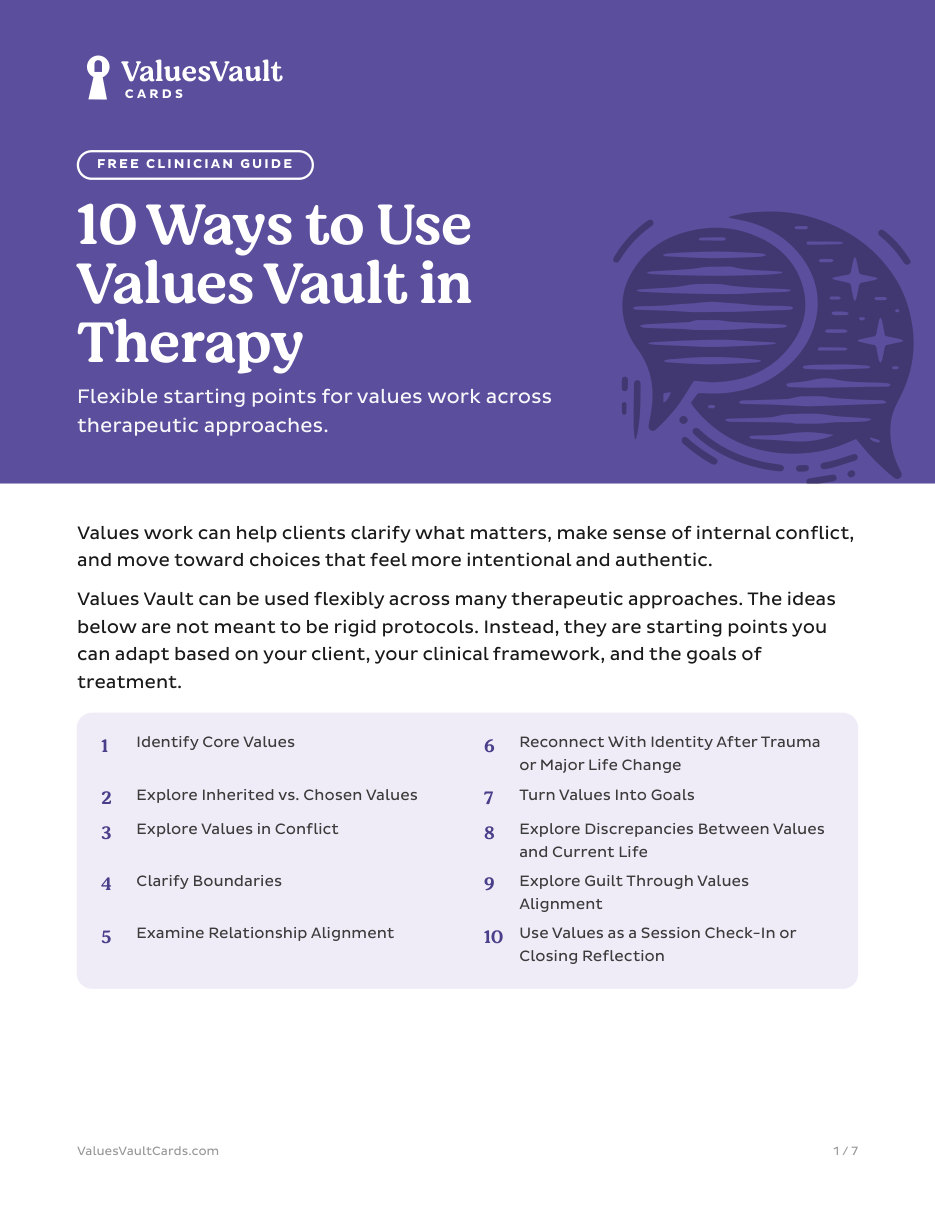
10 Ways to Use Values Vault in Therapy
Ten flexible starting points for values work in session, each with ready-to-use questions. It covers identifying core values, inherited vs. chosen values, values in conflict, boundaries, relationships, identity after trauma or major change, goal setting, guilt, and quick check-ins or closing reflections. Adapt them to your client and your clinical framework.
Printer-friendly layout · Full-color version
Client worksheets
Hand these out in session or send them home between sessions. Each one walks a client through a single piece of values work, step by step.
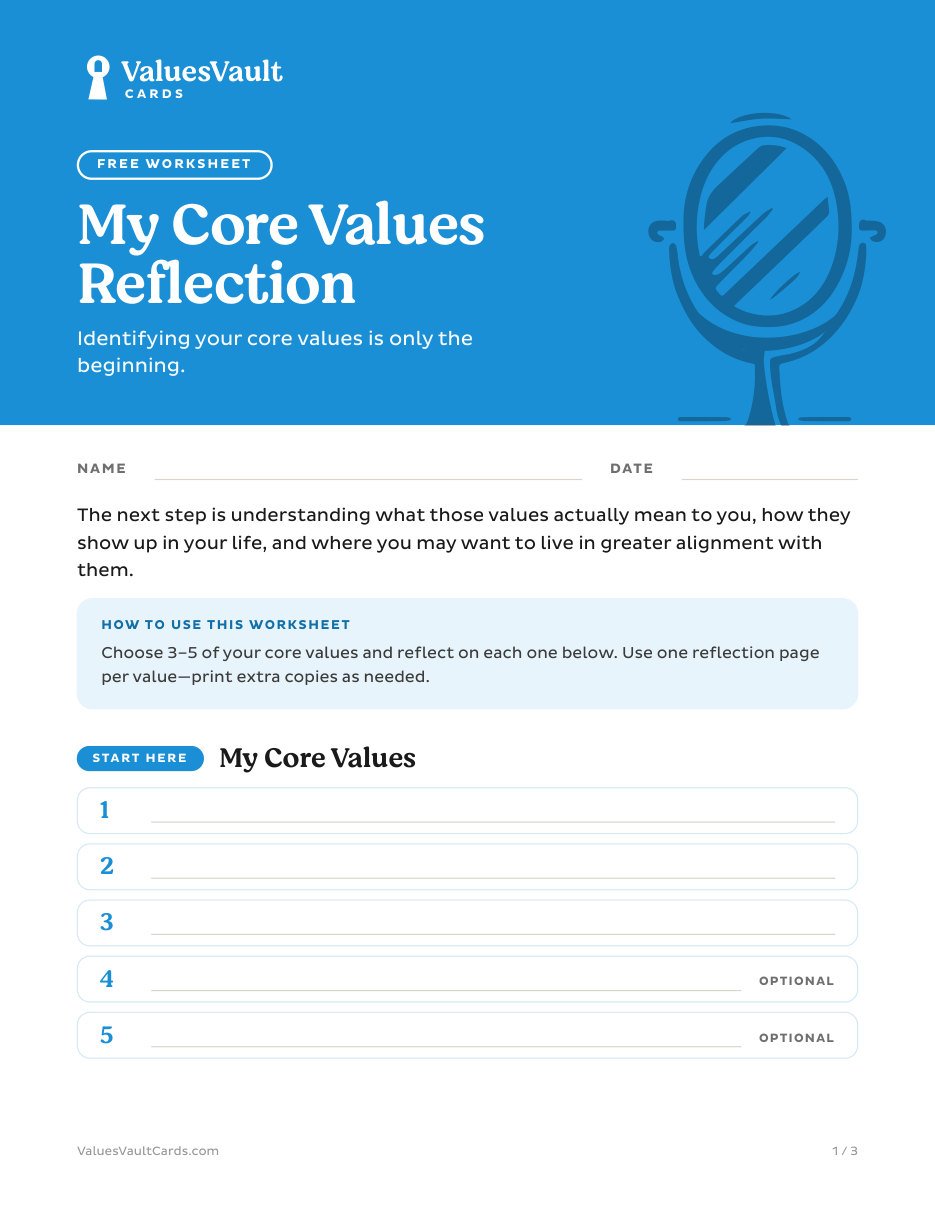
My Core Values Reflection
Naming a value is only the beginning. Clients explore what each core value means to them, where it already shows up, what pulls them away from it, and one small way to honor it more intentionally.
Good for: following up a first card sort
Printer-friendly layout · Full-color version
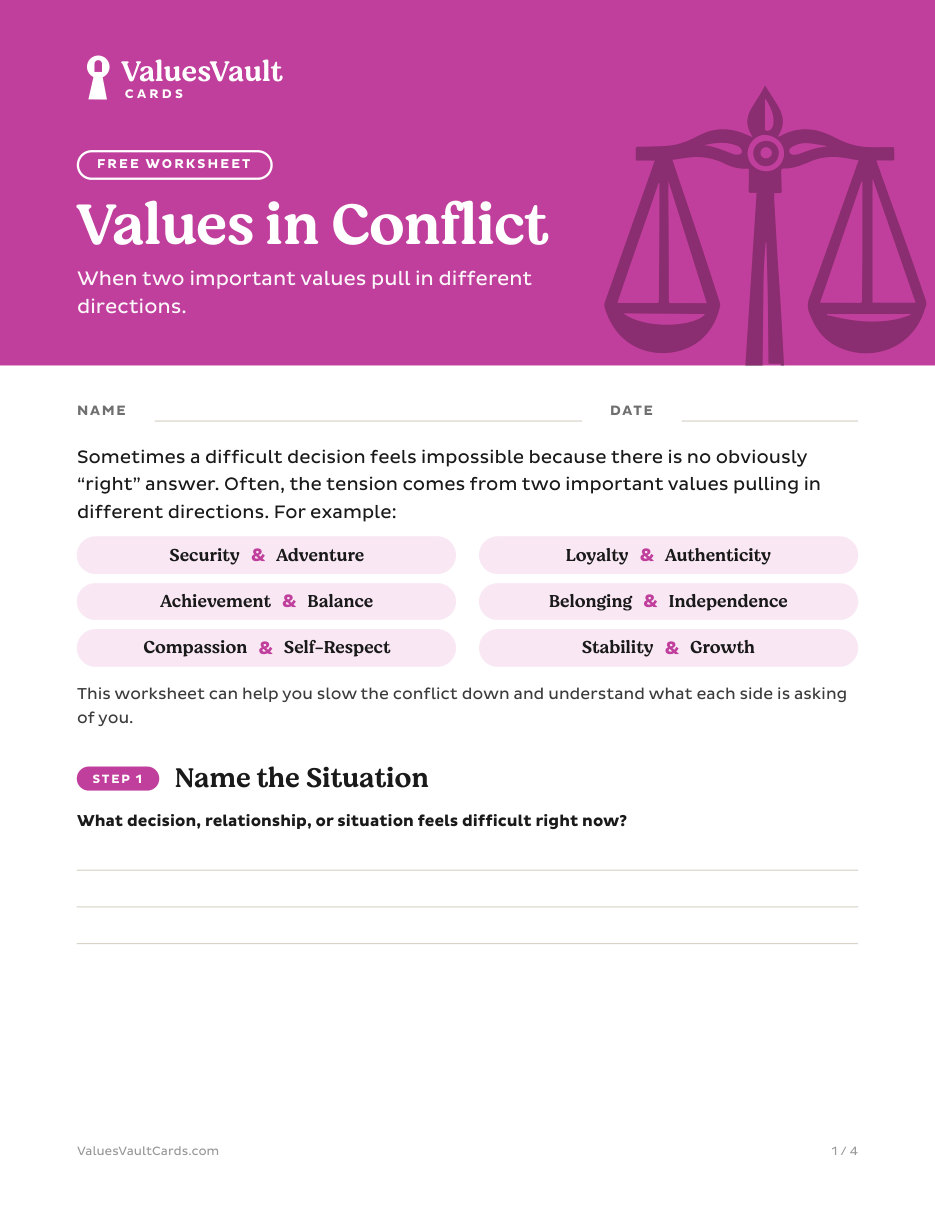
Values in Conflict
For decisions where two important values pull in different directions. Clients slow the tension down, hear what each side is asking for, and look for a choice they can stand behind.
Good for: ambivalence, hard decisions, black-and-white thinking
Printer-friendly layout · Full-color version
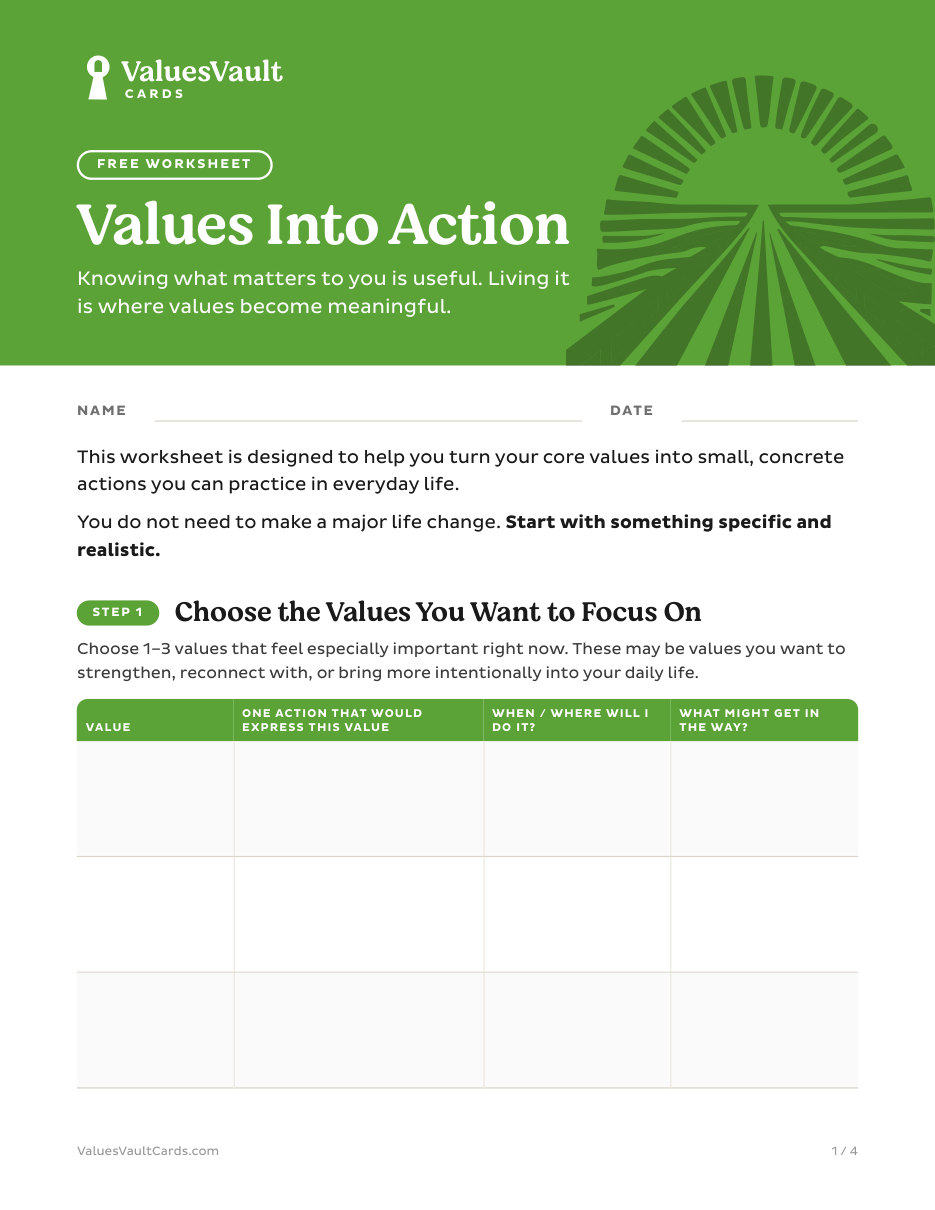
Values Into Action
Turns one to three values into small, specific actions for the week, with room to plan when and where, notice what gets in the way, and reflect on what changed.
Good for: goal setting, practice between sessions
Printer-friendly layout · Full-color version
Career worksheets
Built to pair with the Values Vault Career Edition, and just as useful with your client’s own list of career values.
Career Values Alignment Audit
A job can look good on paper and still feel wrong. Clients rate how much each career value matters against how well their current role supports it, find the biggest gaps, and decide which ones can change.
Good for: burnout, restlessness, job dissatisfaction
Printer-friendly layout · Full-color version
Compare Two Opportunities
Weigh two jobs, roles, programs, or paths side by side. Clients rate each against their career values, separate values from outside pressures, and make the tradeoffs visible before they choose.
Good for: job offers, career transitions, grad school decisions
Printer-friendly layout · Full-color version
Even better with the cards
Every worksheet starts with a set of values. A physical card sort gives clients something tangible to hold, move, and rank, which makes that first step easier and more engaging.
Why values work helps
A few of the ways understanding core values can support the people you work with, plus quick reflection prompts you can use with or without the worksheets. For how Values Vault fits specific approaches, see Modalities.
Values provide a framework for decision-making
Core values are the guiding principles that shape our decisions, actions, and behaviors. When clients know what matters most to them, they can make choices that feel true to themselves rather than reacting to external pressures or other people’s expectations.
Naming conflicting values helps resolve inner tension
Values can pull in different directions at the same time. Identifying which values are at play helps clients understand why a situation feels so hard, and points toward options that honor more than one of them.
Values can help make sense of guilt
Guilt often shows up when actions don’t match values. Sometimes it points toward meaningful repair. Other times it shows up because a client honored their own values while disappointing someone else. Clarifying values helps tell the two apart.
Values are an anchor during stress
When clients face stress or uncertainty, reconnecting with their core values gives them something steady to return to and a way to choose their next step.
Values support differentiation and healthy boundaries
Differentiation is the ability to keep a distinct sense of self while staying emotionally connected to others. Values give clients a clear reason behind a boundary and language for communicating it.
Values guide meaningful goals
Goals rooted in personal values tend to be more satisfying and easier to sustain than goals driven by outside expectations. Once clients have identified their core values, they can set short- and long-term goals that reflect what truly matters to them.
Reflection exercise: values in relationships
Take your top three core values and reflect on how they shape your relationships with family, friends, or coworkers:
- How do your values influence how you communicate with others?
- Where do your values align with, or differ from, the people closest to you?
- How could you communicate your values more clearly?
Tip: Use the cards to start a conversation with a partner or friend about the values you share and the ones you don’t.
Reflection exercise: values in daily life
Take your top five core values from the cards and reflect on these prompts:
- How do these values show up in your daily life?
- How do they influence your decisions, big and small?
- When have these values been tested or challenged, and how did you respond?
Tip: Revisit these questions weekly, or whenever you face a major decision. For a deeper version, download My Core Values Reflection.